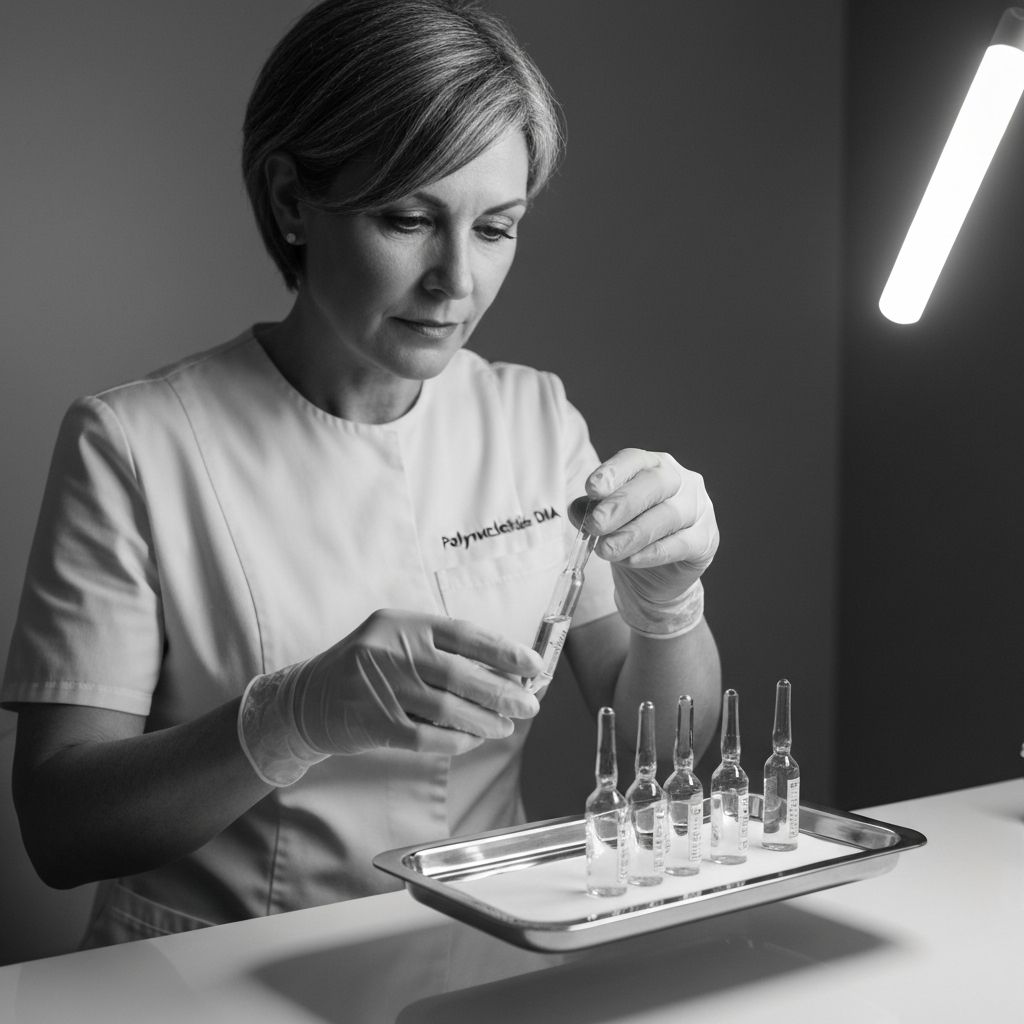
Long before it became the 'salmon injection' of Korean skin clinics, PDRN was a hospital medicine for wounds that refused to heal. Doctors used it because it helps damaged tissue repair itself and calms inflammation. Skin that is scarred, red or worn out responds to the same signal.
In people with stubborn diabetic foot ulcers, twice as many wounds closed completely with PDRN as without it, and weeks sooner. That repair effect is why PDRN has become one of the most requested regenerative treatments of 2026. This guide explains what it is, what it genuinely helps, how it compares with polynucleotides and skin boosters, and what a course looks like at Alpha Medical in Limassol.
What PDRN is
PDRN is DNA extracted from salmon and purified until only short fragments of the DNA chain remain. Salmon DNA is used because it is structurally close to human DNA and very well tolerated, and the purification removes the proteins that would otherwise trigger a reaction.
Once injected into the skin, those fragments do two things. They activate adenosine A2A receptors, which damps down inflammation and encourages new small blood vessels to form. They also feed the salvage pathway, supplying ready-made building blocks to cells that are busy repairing themselves. A 2020 systematic review of 34 laboratory and clinical studies found both mechanisms at work and linked PDRN to faster, more complete tissue repair.
What PDRN treats in the clinic
Because it works on repair and inflammation rather than volume, PDRN is at its best on skin that is damaged, reactive or slow to recover. At our Limassol clinic we use it for:
- Acne scarring and uneven texture, often alongside microneedling
- Redness-prone and sensitive skin, including rosacea
- Healing after laser, peels or microneedling, to shorten recovery
- Dull, tired skin that has lost its bounce
- The thin skin under the eyes, where fillers can look heavy
- Fine lines and early loss of elasticity
PDRN vs polynucleotides vs skin boosters
PDRN and polynucleotides (PN) come from the same salmon DNA. The difference is chain length. PDRN products are made of shorter fragments that spread easily and act mainly as a repair and anti-inflammatory signal. PN products keep longer chains that form a gel in the skin and give more support, which is why they are popular for crepey under-eye skin. Rejuran, the Korean brand many people search for, is a polynucleotide product. The two names are often used interchangeably, and a 2025 review in Biomolecules proposed defining them by fragment size to end the confusion.
Hyaluronic acid skin boosters such as babyGLOW™ and Skinvive work differently again: they bind water and improve hydration and glow. We often combine the two approaches, with PDRN to repair and a booster to hydrate. Our polynucleotides guide covers the PN side in more detail.
How a PDRN treatment works at Alpha Medical
Your first visit starts with a skin assessment. Your physician looks at texture, scarring, redness, thickness and how your skin has responded to previous treatments, and builds a protocol around the main concern rather than a fixed menu.
On treatment day the skin is cleansed and, where needed, numbed with a topical cream for 20 minutes. PDRN is then placed with fine microinjections or with the Mesogun U225, which delivers even micro-doses across a whole area and is gentler on reactive skin. A full-face session takes around 30 to 40 minutes. For scarring we usually pair it with microneedling in the same visit, so the PDRN works on skin that is already in repair mode.
Results, sessions and recovery
Most patients notice calmer, more even skin after the second or third session, and the improvement keeps building through the course. A typical course is 3 to 6 sessions spaced 2 to 4 weeks apart, with maintenance a few times a year. Scars and redness usually need the longer course; general skin quality often responds to three sessions.
Small raised bumps at the injection points settle within a few hours to a day, and occasional pinpoint bruises fade within a few days. Most people go back to work the same day. Skip make-up for the rest of the day, avoid the gym and sauna for 24 hours, and use daily sunscreen through the course.
Who PDRN suits
PDRN suits almost any skin type and tone, and it is one of the few injectables that reactive skin often tolerates better than standard boosters. It fits patients from their late twenties who want to prevent early changes, patients in their forties and fifties with thinning skin, and anyone recovering from resurfacing. Tell us about any fish or salmon allergy at the consultation, and plan PDRN outside pregnancy and breastfeeding.
Patients from Nicosia, Larnaca and Paphos often combine a PDRN session with another treatment in the same visit to our Limassol clinic.
Ready to take the next step? Book a consultation at our contact page — or request an introductory Medical Aesthetics guide below.